

Campus Protest Policy
Protest and event management policies may have unintended consequences

I have been researching recent changes to campus protest policies made by University’s in the past few months as part of my book project. The recent round of protests at Columbia and Barnard are egregious and should not be tolerated and have not been. Barnard students disrupted a Columbia class on Israeli history (the two institutions are across the street from one another and students at each can take classes at the other) and the protesting Barnard students were expelled from Columbia’s campus and are unable to take classes there any longer. In response, protesters took over a building at Barnard to protest the punishments and to further ask for no punishment for protesting.
There have to be limits to protest, and doing things like disrupting a class because you do not like something about it is unreasonable. Take the class and make your case, and also learn more about your opposition, or write about your views. But don’t stop others who do want to take the class. It should go without saying, but physical violence and intimidation are never ok as a part of any protest.
The point of protest is to say “stop and listen” and at times you may have to be willing to suffer consequences to make your point.
Closer to home, the University of North Carolina Board of Governors (policy body for all 17 campuses) approved a revised protest policy at their February 28, 2025 meeting. This follows protests during the 2023-24 academic year that included a free Palestine encampment at UNC Chapel Hill that resulted in arrests when it was broken up. The most consequential change is requiring protests to be pre-approved; an impromptu protest would be inherently contra the policy. The same is true at Duke. My worry is that these well-intentioned policies have unintended consequences and do not address our biggest problem which is student self-censorship or apathy.
Protest Policy at Duke
There have been some changes in Duke University’s protest policy this academic year, and I wrote recently about some folks speaking out against Duke’s changes, particularly the requirement that such gatherings be planned up to 30 days in advance. It is difficult for me to put my finger on why the expansion of rules and the management and routinization of protest at Duke rankles me. This is me trying to think through it, and then get to some suggestions for how faculty can better engage these issues.
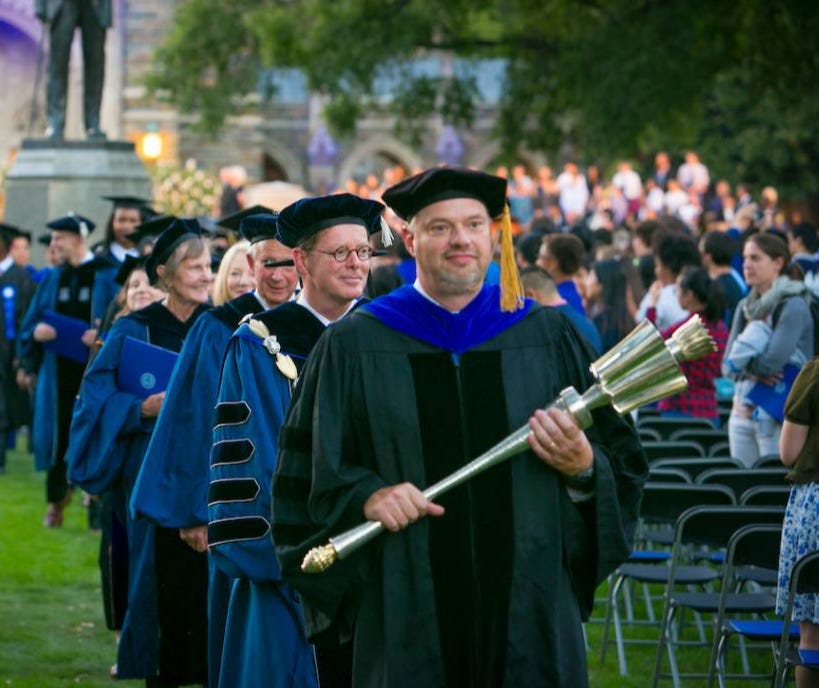
Protest is a quintessential American idea, born of a violent Revolution against a Monarch. Once we had a Constitution, then we had ways to “fight” in non-violent ways. The impulse to protest concentrated power feels righteous, and remains, but the prohibition against physical violence is absolute on a college campus. Part of my angst may simply be that since I am a tenured full professor who has had all sorts of leadership posts at the University, I am in many important ways, “the man.” Maybe this is just hard for me to accept. I do not like thinking of myself as “the man” but there I am leading the procession for the inauguration of President Vince Price, in October, 2017.
When folks protest, it means they feel they cannot participate and they are frustrated. So the impulse to protest represents a failure of an intellectual community. When I think of Duke’s campus culture, the biggest problem we have is not controlling protests run amok, and I am worried that our policies have unintended, chilling effects. But again, what we really need is more speech and participation. Protests at Duke have been over the line in the past, such as when the People’s State of the University shouted President Price off the stage in April, 2018. However, bad protest is not our biggest problem.
Duke should strive for an intellectual community that errs on the side of more speech, when combined with individuals taking responsibility for their words. People should be able to say just about anything they wish outside of true threats, so long as they will own their words and be prepared to have someone speak back. It is possible that slurs written anonymously may be constitutionally protected in many/most/some cases, but a community of scholars can say that if you are not going to own your words, we will not take them seriously. In this way, a community of scholars can “defang” hateful speech by ruling it out of bounds and being unworthy of the time of a response. The community can also state that a targeted group does belong. These are examples of more speech crowding out the effect of bad speech without banning it.
The principle of being able to say just about anything so long as you own it causes me to dislike folks protesting with their faces covered. I think that I am likely capable of worse actions if I think I am anonymous, so having your identity be clear is a type of self-governor on potentially bad actions. Your identity being clear as a member of a given intellectual community means that you are staking your reputation in same on your words and behavior. At the same time, some students and others say they fear being unreasonably targeted, and I do experience Duke from a position of relative power and prestige that others do not have, especially students.
I think my biggest problem with the emerging culture of protection/discipline around protest Duke is how much energy we are investing to manage or control events of all types, including protests. Please do not hear me saying that I want violence. I certainly do not want chaos on campus, or in my classroom. I am just worried that we do not seem to be able to trust our students to figure out some of these issues without a great deal of guidance and not control, and that all the energy and time could be put to better uses. Also, I want to be clear that my friends and colleagues in student affairs at Duke are passionate about our students and the fully believe they are doing the right thing here.
College is supposed to be a time for students to spread their intellectual and social wings in an environment that does provide some protection, but that lets them experience learning that is often best enhanced (unfortunately) via mistakes. I think our culture of protecting students has gone overboard in the management of events and protest and we need to talk about how we might change things as a community.
Duke’s gathering and event policies are more intrusive than I realized
Until last week, I had focused mostly on the protest policy at Duke that bans disruptive pickets, protests and demonstrations. I think this policy is overbroad and vague, and that leaves open the possibility of unfair application and/or not following normal disciplinary processes. Most importantly, it may have an unintended chilling effect on discourse and debate on campus. However, our biggest problem is the expansiveness of the rules about what it takes to have an ‘approved’ gathering at Duke. A friend wrote me about the following anecdote from a piece last week and said “you need to read Duke’s PPD policy more closely—the student was right. Everything has to be registered.” Below is a snippet from what I wrote last week:
One of the most troubling things I heard during the semester was in a small group discussion (me consulting with and providing feedback to a group on their project draft) and a student mentioned wanting to set up salons where ideas could be discussed, organized by students. A member in the group’s first impulse was to wonder if such an event would have to be registered 21 days in advance in case someone….well I am not sure what they were thinking…. but I lost my shit. That this bright, energetic 19 year old’s gut reaction to a proposal for a student-organized salon was that Duke’s PPD policy might mean they would have to get permission to get together and talk about topics of mutual interest is worrying.
So, I went and looked more closely at the student affairs website and found this detailed set of rules for a student to schedule an event of any sort at Duke. I am unsure of how long these have been in force, but the community standard was last changed in August, 2024, so I assume these rules have been in force this academic year. Maybe they have been this detailed for longer and I just did not know.
Here are detailed quotes from the policy to give you a sense of the thoroughness and expansiveness—I am sure there are folks who see this as evidence of great policy, and in one sense I agree. I am just worried about the unintended consequences. The scope of the policy is quite broad:
Event: any gathering, meeting, event or activity, regardless of size, that occurs in a university building or outdoor space centrally managed by Campus Life, whether on or off campus. An event may be course-related, non-academic, or community-sponsored including, but not limited to, social, cultural, vigils, educational, academic conferences, student organization activities, guest lectures, and social gatherings.
Event Organizer: the individual or organization/group responsible for the planning and execution of an event in accordance with this and related university policies.
This is way too broad in my opionion. I am not sure what type of event it doesn’t cover. It must not be the case that this would not include some students getting together in the dorm commons room and talking about….well, anything? Maybe that space is not “centrally managed by Campus Life"? I am unsure, but someone please tell me the kids can just get together and talk about a book in the dorm if they want to do so? I am stunned by the detailed nature of the rules about planning an event for students.
All events must be registered and approved in advance. Event request should include all details about the event including, but not limited to, desired location and purpose of the space, anticipated size of the event, noise, event plan, site map, designated point of contact, and if a temporary structure is requested, specifications for the structure. A fund code must also be provided with the request.
I am not sure what the cost of having an event might be, but a fund code implies some sort of registered group. I guess that means more informal groups cannot have events? I find that hard to believe, or maybe it is very easy for students to create “a group.” Not sure.
Event organizers must submit requests as follows:
Requests for outdoor events at least 15 days in advance;
Requests for indoor events at least 5 days in advance; and
Requests, whether indoor or outdoor, where a temporary structure is needed, at least 30 days in advance.
Event organizers must submit requests for approval to the appropriate office in Campus Life or to the academic department for academic or administrative events within a department. Event organizers can use Space Finder to locate space and submit requests. In addition, any event hosted by a student or recognized student organization must also be submitted in DukeGroups for approval by Student Affairs.
Event organizers must wait for approval and notice of registration before proceeding with any further event related activities including advertising or setting up structures. Duke reserves the right to determine whether to approve or deny an event based on a range of factors including, but not limited to, the purpose of the space, anticipated size of the event, official university events, impact on university educational activities or other essential functions, adequate and suitable accommodations in the requested location, compliance with applicable laws and university policies, and potential risk to the health or safety of participants, observers or other members of the Duke community.
Once approved and registered, the event organizer will be notified and an agreement completed that includes all agreed upon details for the event, including any necessary insurance requirements or additional costs for external organizations. Event organizer may not transfer approved reservations to another individual or organization or use the space for some other purpose.
Student organizations (recognized or university sponsored) must submit a post-event report in DukeGroups within 10 days after the event, including details on attendance, any incidents and financial outcomes.
In the book The Coddling of the American Mind (2018) Lukianoff and Haidt argue that universities are beset by “safetyism” that flows from an overactive ethic of harm reduction at universities. Now I have a Ph.D. in Public Health, so love me some harm reduction, but you need to be clear about what you want less of, and their book is a warning about throwing the baby out with the bathwater. Lukianoff and Haidt identify student-centric explanations for the rise of safetyism, such as lack of unstructured play time and hovering parents in primary school that stunt young people’s development of problem solving and resilience. They note that universities respond to the desires and expectations of parents and students by responding with numerous forms of programming that emphasize student well-being and safety to the detriment of their intellectual development on campus.
Certainly my colleagues and friends in Student Affairs at Duke do not wish to truncate the intellectual development of our students. There are numerous tradeoffs between safety and the robust functioning of campus culture. An example of Duke well-balancing safety and Duke tradition is students sleeping in tents in order to get a better seat for the basketball game against UNC. It makes no sense to sleep in a tent for such, and it is a miracle no student has died from exposure or alcohol poisoning in the four decades that this tradition has been in force. And that is in large part because of how controlled the campout actually has become in recent years. And when Duke beats UNC as they did for both the men’s and women’s home games this year, there is a ritual burning of benches on the quad, highly organized with fire department on the ready. Duke students figured out how to burn benches before it was highly organized and the fire department granted a burning permit even before the game, but it is certainly safer now.
We need to put the same level of energy into working out the fine line between intellectual discovery and danger from protest gone out of control on campus. The risk of such protest is certainly not zero, but I do not believe that we have the equipoise we need between protection from impromptu protest and encouraging the intellectual culture on campus to be robust. The overly managed event scheduling policies seem likely to have unintended consequences.
How Can Duke Jumpstart the Marketplace of Ideas on Campus?
Duke cannot change parenting patterns and habits, but we do control what we invite students to join, and both the good news and bad news is that we get a chance to start anew every August. Good news in that we have an opportunity to alter the expectations for our new students—what they can expect from us and what we expect from them. Bad news in that we run the risk of responding to what has happened reflexively and only in piecemeal fashion. Making perpetual and ongoing tweaks may keep us from thinking anew—I think we need a big change and the faculty should be the primary drivers of it as the intellectual leaders of the campus and only comparative advantage that a University has over other type of knowledge-producing organizations. These are some ideas around which we could have a conversation on campus.
What is enough evidence to change your mind? This is really the overarching question facing our culture and the one that we should be equipping students to answer. Faculty can make simple changes in how we teach any course by explicitly providing examples of when, how and why we have changed our mind’s based on evidence in our research expertise. This is not changing the curriculum to fit our research, but simply bringing our experience as people who expect to change our minds front and center. The point is that we expect to change our minds in what we know and care the most about—that is why we conduct research. We need to celebrate the ability to change one’s mind based on evidence and experience, not denigrate it as our culture often does. We want to be flip floppers who do so based on evidence and rational thought.
Let’s use our low acceptance rate to be clear about what we are calling students to. Duke’s very low acceptance rate (6%), means that we turn away so many capable students who would clearly thrive at Duke. We should be clearer about what we are calling them to join—an intellectual community. We have a responsibility to prepare them for the next step in their career journey regardless of major (education as a private good) in helping them learn to think differently. However, given the largess of resource we put into undergraduate education we need to emphasize student responsibility beyond their own lives (education as a public good). This is not about selection of students, but clarity of the intellectual culture we are inviting them to join. We need to call them to more and be sure that we are ready to model this life of public good production.
Faculty need to re-engage the intellectual lives of undergraduates more wholistically. The faculty/staff divide at Duke and higher education generally is overdone—there are so many professionals at Duke who make the place work. We faculty need to acknowledge this and say thank you more. At the same time, the faculty need to make sure that we do not abrogate our duty to frame the broader intellectual culture of our students. Back in the late 1990s and early 2000s when Public Policy was a Trinity Department and not a School, I had a number of students for whom I served as an advisor. I also served two years as a first year advisor, when I got 10-12 frosh whom I met the day they moved into the dorm and helped with course selection. We have now mostly professionalized advising, and I do get to know undergraduates whom I teach and hire on research projects, but have less contact with a broad cross section of students. I must say that I willingly went for this trade because it meant I got to spend more time on my research. I think we have over done that and we need to reconsider how the faculty can reassert intellectual leadership for the broad undergraduate student body as a whole.
The Pickets, Protest and Demonstration policy and event management policy are a part of our intellectual culture at Duke. These policies should not be viewed in isolation and only driven by fear, and the possibility of someone being injured. The faculty need to step up and be engaged in a broader discussion of the intellectual culture at Duke, and especially addressing what I hear students saying in my classes—we are ‘pre-professional’ and so worried that taking controversial stands or even engaging in discussion of them will hurt our job prospects. They have well learned, and probably over learned the truism that the ‘internet is forever’ and we need to determine how to bring a culture of grace and benefit of the doubt to our undergraduate student intellectual culture. We need to trust them to self-manage, and tell them we expect them to be able to do so. We need to get all the parts of the undergraduate experience working toward addressing the most important question of our day—what is enough evidence to change your mind?
A year ago students and i held a climate protest to ask Duke’s administration to be more transparent and engaged about their climate commitment and endowment (in terms of carbon emissions). We camped for a week (i lasted longer than they did). In tents. We engaged with other students on the topic. Had a conversation with VP Steelman’s office (they gave me a tarp, i was quite damp). The Administration knew that this was happening prior to the event (but not 30 days). We did not fill out any permits nor did we make any official requests. We spoke freely and caused little to no harm, and perhaps some thoughtful engaged discussion. It saddens me we can’t do this anymore.
I know you are spending more time here than on your email. Just sent you a note that needs a bit of attention. Thanks, DS